Game Design
Designing Reward Loops That Keep Players Hooked (Without Manipulation)
A practical guide to creating fair, habit-forming systems that drive retention and trust.
TL;DR
- Reward loops are the heartbeat of player retention — the “why” behind replay.
- There are three major loop types: Core, Meta, and Social.
- You can make loops engaging without exploiting psychological tricks.
- A good loop balances effort, reward, and timing to create satisfaction, not addiction.
Introduction
Every great game — from Candy Crush to Clash Royale, from Valorant to Royal Match — runs on invisible loops that keep players coming back.
Players may say they love the art, characters, or story. But underneath it all, what keeps them playing daily is one simple system:
The Reward Loop
As designers, understanding how these loops work — and how to build them responsibly — is one of the most important skills you can master.
In this post, we’ll break down:
- The structure of reward loops (Core, Meta, Social).
- Examples from successful games.
- Formulas to measure engagement and pacing.
- Ethical principles to avoid manipulation.
By the end, you’ll know how to make your players feel rewarded, not exploited.
What Is a Reward Loop?
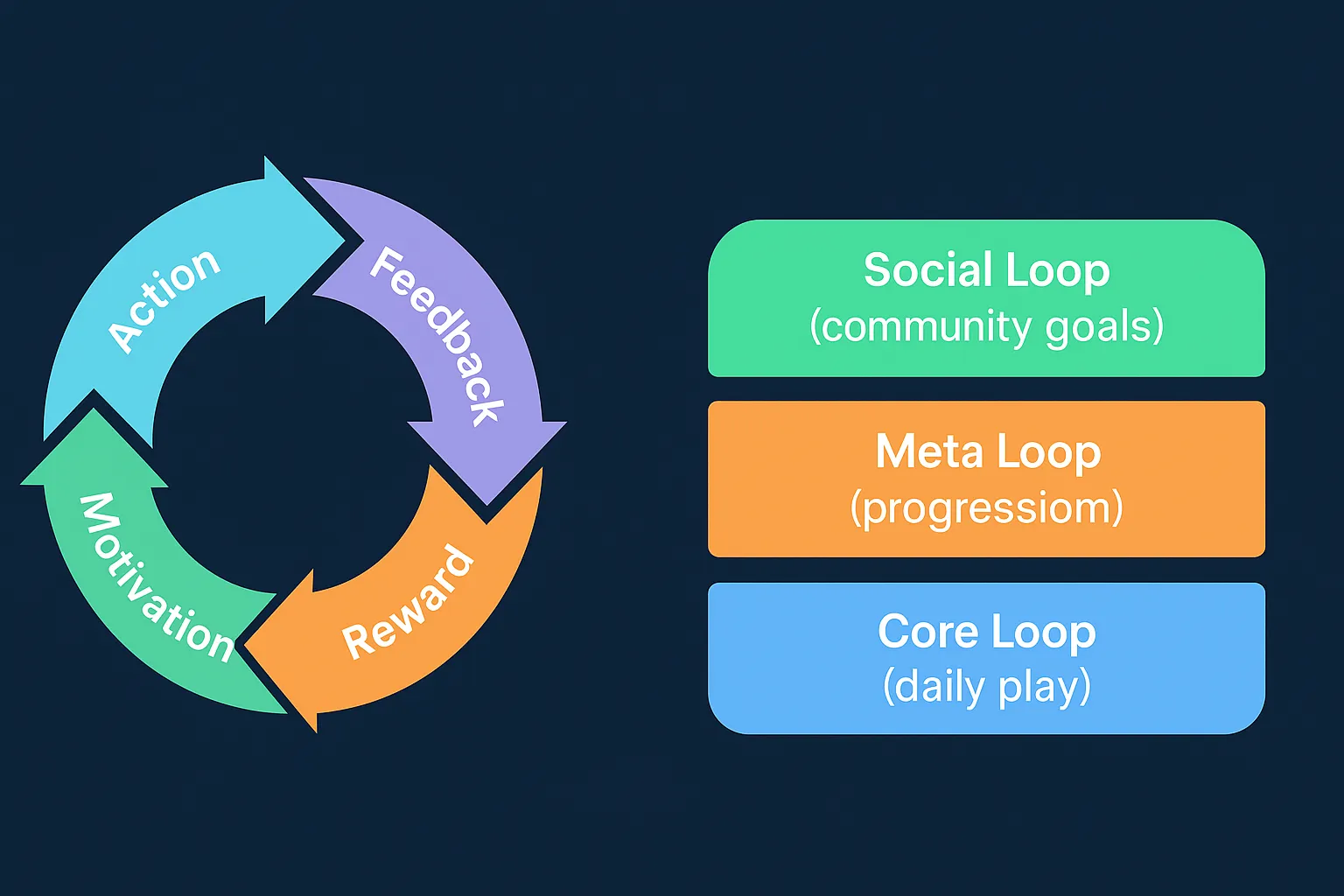
A reward loop is a repeating cycle of Action → Feedback → Reward → Motivation that encourages continued play.
It’s not about giving players random goodies — it’s about giving them meaningful progress that aligns with their motivations.
At its simplest, the loop looks like this:
Player Action → Challenge → Reward → Satisfaction → Motivation → New Action
When done right, this cycle feels natural — like breathing inside a game world.
When done wrong, it feels manipulative — like a slot machine.
The key difference? Intention.
Good design says: “I want to motivate players to improve and explore.”
Bad design says: “I want players to stay just for dopamine spikes.”
The Three Layers of Reward Loops
1. Core Loop — The Daily Habit
This is the moment-to-moment gameplay that repeats every few minutes.
Example (Clash Royale):
- Play match → Win trophies → Unlock chests → Wait → Play again.
Example (Royal Match):
- Match candies → Earn coins → Decorate room → New level unlock.
Formula:
Core Loop Time = (Avg Playtime per Session × Frequency per Day)
Typical values for mobile games:
- Session = 3–5 minutes
- 3–6 sessions per day
💡 The goal is to make the loop feel rewarding enough to repeat daily without fatigue.
2. Meta Loop — The Long-Term Progress
This is what makes players invest emotionally.
It connects multiple core loops into a feeling of growth.
Example (Clash Royale):
- Level up cards → Build stronger deck → Unlock new arenas.
Example (Genshin Impact):
- Collect characters → Upgrade → Explore → Unlock story arcs.
Formula:
Progression Velocity = Total XP Earned per Day / XP Needed for Next Tier
Good pacing = 3–5 days per milestone (for casual games).
The meta loop gives meaning to the grind. Without it, daily play becomes repetitive.
3. Social Loop — The Community Pull
This loop uses other players as part of the reward system.
Competition, collaboration, or social recognition becomes the reward itself.
Example (Ludo King):
- Win against friends → Rank higher → Share victory → Play again.
Example (Clash of Clans):
- Clan wars → Shared goals → Collective rewards → Community loyalty.
Formula:
Engagement Boost (%) = (Avg Session Time With Social Features / Avg Session Time Without) × 100
Usually, social features increase engagement by 30–60%.
You don’t need multiplayer to have a social loop.
Leaderboards, gifting, or event rankings can be enough to create community-driven motivation.
Why Reward Loops Work (The Psychology Behind It)
Reward loops rely on human motivation patterns:
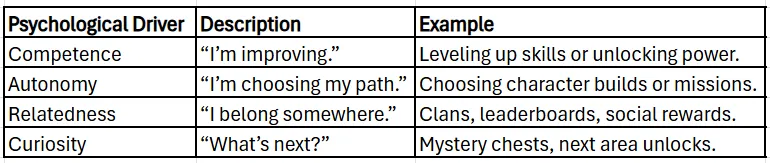
Variable Reward Theory
A consistent but slightly unpredictable reward schedule keeps engagement higher.
The trick is balance — predictable progression + surprise bonuses.
Example: Candy Crush daily wheel + streak rewards.
The 3:1 Ratio Rule
For every three effort moments, give one meaningful reward (XP, visual upgrade, or narrative beat). Keeps dopamine response healthy without burnout.
Designing Your Own Reward Loop
Let’s build one step by step.
Step 1: Define the Core Action
Ask:
“What do I want the player to do repeatedly?”
Examples:
- Solve puzzles
- Win battles
- Explore environments
Step 2: Define the Reward
Ask:
“What does the player get that feels good?”
Examples:
- Coins, XP, items
- Narrative reveal
- Cosmetic upgrade
Step 3: Define the Motivation Link
Ask:
“Why should they care about this reward?”
Example:
- “Because it unlocks power.”
- “Because it beautifies my space.”
- “Because it helps my team.”
Step 4: Close the Loop
Connect the reward back to the core action:
“Reward enables the player to take the next, more exciting action.”
Example: Mini Reward Loop (Royal Match)

Mini Formulas for Loop Design
1. Reward Frequency
RewardFrequency = (Average Session Time / Time Between Rewards)
For casual games, players should see a reward every 30–90 seconds (even small ones).
2. Effort–Reward Balance
RewardRatio = (Player Effort in Minutes) / (Perceived Reward Value)
If this ratio exceeds 5:1 → frustration risk.
If below 1:1 → inflation (no sense of achievement).
3. Emotional Pacing
Peak Reward Interval = Avg Time Between “Big Win” Moments
Players should experience a major sense of accomplishment every 10–15 minutes of continuous play.
Visualising Reward Loops
Ethical Reward Design — Engagement Without Exploitation
Designing for long-term engagement should never cross into player manipulation.
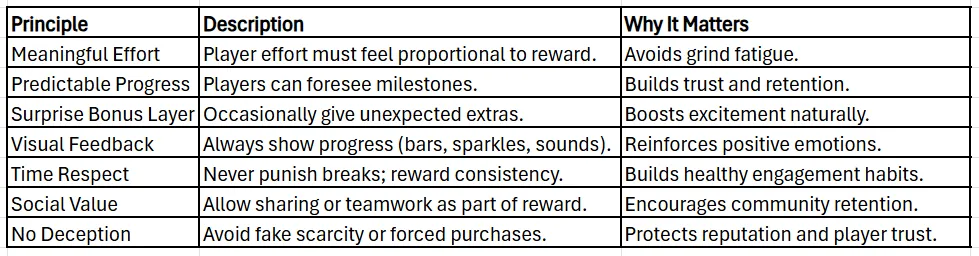
Here are the “Do’s and Don’ts” that define ethical loop design:
DO:
- Give players agency (choice-driven progress).
- Make rewards clear, not confusing.
- Use predictable progression with mild surprises.
- Build intrinsic motivation (fun, mastery, community).
DON’T:
- Use dark patterns (fake scarcity, hidden timers).
- Force engagement through FOMO (fear of missing out).
- Reward only with currency — emotional rewards matter too.
- Punish players for taking breaks.
The golden rule: If your game feels like it’s respecting players’ time*, they’ll reward you with loyalty.*
Case Study 1: Clash Royale — The Chest Loop
Core Loop: Battle → Win → Get Chest → Wait → Open → Upgrade Deck.
Meta Loop: Level up → Climb Ladder → Unlock New Arenas.
Social Loop: Join Clan → War → Earn collective rewards.
Why it works:
- The waiting chest system creates anticipation, not frustration.
- Rewards scale with rank (effort is justified).
- Clan wars turn meta goals into social rewards.
Lesson: Use time as a tool for pacing, not punishment.
Case Study 2: Candy Crush — The Streak Loop
Core Loop: Match → Win → Earn Stars → Next Level.
Meta Loop: Progress Map + Power-up Unlocks.
Social Loop: Compete on leaderboard + ask friends for lives.
Why it works:
- Each match delivers a consistent dopamine hit.
- Visual map progression gives clear sense of journey.
- Social sharing boosts habit retention.
Lesson: Simplicity + clarity = long-term replayability.
Case Study 3: Royal Match — The Restoration Loop
Core Loop: Match candies → Earn Stars.
Meta Loop: Use Stars to decorate castle.
Social Loop: Team events + global leaderboards.
Why it works:
- Rewards are aesthetically satisfying (player ownership).
- Visual feedback (clean → beautiful) = emotional payoff.
- Players feel progress even when they lose levels.
Lesson: Emotional ownership is more powerful than currency rewards.
Checklist: Designing Ethical, Engaging Reward Loops
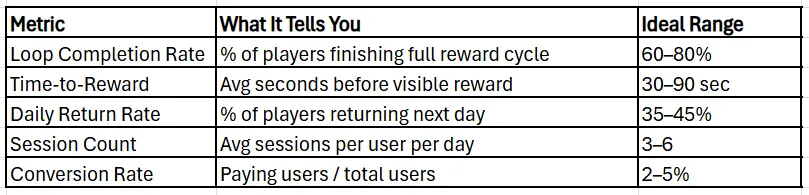
Quick Metrics for Testing Loop Health
Tuning Loops for Longevity
Early Game:
- Reward frequency = high (teach dopamine rhythm).
- Feedback = instant (clear wins).
Mid Game:
- Introduce meta goals (collection, customization).
- Add friction carefully — growth feels earned.
Late Game:
- Focus on community + mastery (events, rankings).
- Introduce prestige/rebirth loops.
A good game loop doesn’t trap players — it evolves with them.
Closing Thoughts
Reward loops are not about manipulating emotions — they’re about aligning fun with fulfillment.
When your game gives players a rhythm of effort, payoff, and anticipation, you don’t need tricks to keep them playing.
They’ll come back because they want to, not because they have to.
As a designer, your goal isn’t to chase dopamine spikes — it’s to design systems that respect time, reward curiosity, and sustain trust.
That’s how you turn loops into legacies.