Industry
Why Game Designers in India Need to Think Like Product Managers
Creativity is no longer enough — today’s game designers must understand data, player behavior, and business outcomes.
TL;DR
- Game design and product management are now deeply connected.
- Indian designers who learn metrics, retention loops, and A/B testing will grow faster in the industry.
- Thinking like a product manager doesn’t kill creativity — it strengthens it with purpose and results.
When I started my career in game design, the only numbers I cared about were damage values, cooldown timers, and XP curves.
But over the years, especially in the Indian mobile gaming space, I realized something crucial — great design alone doesn’t guarantee success. You can have stunning visuals, polished mechanics, and clever level design — but if your players churn in three days, it’s all gone.
That’s when I understood:
A modern game designer must think like a product manager.
It’s not about giving up creativity; it’s about giving it direction — turning great ideas into systems that work for both players and business.
The Changing Landscape of Indian Game Design
The Indian game industry has evolved from service-based outsourcing to original IP creation. Most of the Indian studios are experimenting with retention-driven F2P games — not just polished gameplay.
This shift has changed what “success” means. It’s no longer:
“Did players like the game?”
But rather:
“Did players return tomorrow, and did they spend while having fun?”
That’s the language of product management — retention, conversion, engagement, and LTV (Lifetime Value).
As a designer, if you can understand these, you instantly become 10× more valuable to any studio.
Designers vs. Product Managers: The Real Overlap
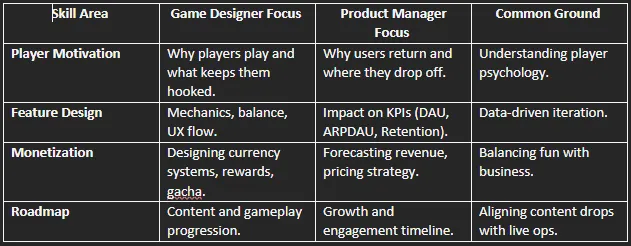
So, instead of asking:
“Is this level fun?”
Ask also:
“Does this level improve our Day-3 retention or encourage spending without forcing it?”
That’s the mindset shift.
Why Thinking Like a PM Makes You a Stronger Designer
1. You Design With Data, Not Guesswork
A designer’s instinct is great, but data keeps you honest.
When you think like a PM, you begin to validate creative ideas with actual player behavior.
Example:
If your new daily reward feature boosts Day-7 retention by 5%, you’ve just quantified the fun.
Retention Impact (%) = ((NewRetention - OldRetention) / OldRetention) × 100
2. You Balance Player Emotion and Business Reality
A PM mindset helps you avoid extremes — neither too generous nor too greedy.
You understand that player frustration and business goals can coexist if designed right.
Example:
- Free players get consistent rewards → retention.
- Paying players get time savings → monetisation.
Result: Both groups feel valued.
3. You Start Thinking in Loops, Not Levels
Traditional designers think in levels — content progression.
Product-minded designers think in loops — engagement cycles.
For instance:
Play → Reward → Upgrade → Show Off → Repeat.
This loop defines your retention, not the number of levels you have.
4. You Learn to Communicate in Business Language
In leadership meetings, data talks louder than aesthetics.
Instead of saying:
“Players love the new event.”
You can say:
“The event improved DAU by 8% and doubled average session time.”
That’s how you get buy-in from executives, marketing, and investors — without losing your creative voice.
The 5 Skills Every Designer Should Borrow from Product Managers
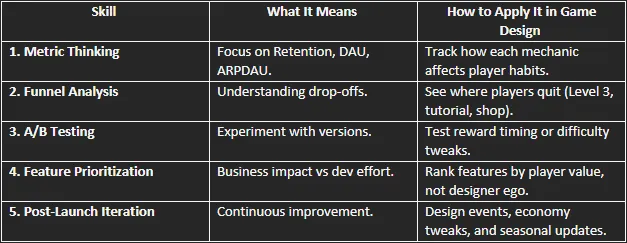
If you can speak both the “fun” language of design and the “data” language of PMs, you become irreplaceable.
Real Example: How Product Thinking Saved a Game
A studio I worked with had a puzzle game where players were leaving after level 12.
The design was solid — clear goals, fair difficulty, smooth UX.
When we looked at data, the energy system was blocking progression.
Players had to wait 30 minutes to play again, which killed engagement.
We adjusted the energy formula:
Old: 1 Energy = 10 mins
New: 1 Energy = 5 mins + optional ad refill
The result?
- Day-1 Retention ↑ 12%
- Day-7 Retention ↑ 7%
- ARPDAU ↑ 15%
That’s product thinking in action — fixing design through player data.
The Future: The Hybrid Role — Designer x PM
Modern studios are already merging these two disciplines.
- Designers are learning Excel and analytics tools.
- PMs are learning player psychology and UX.
This hybrid “Design-PM” mindset will define the next generation of Indian game leaders.
If you can:
- Design experiences players love, and
- Measure outcomes with business impact,
You’re not just a designer anymore — you’re a decision-maker.
Conclusion
Game design is no longer just about fun. It’s about impact.
When you think like a product manager, you don’t kill creativity — you amplify it.
You begin to understand why players behave the way they do, what motivates them to stay, and how your creative decisions shape business success.
In the end, the best designers are not just artists or analysts — they are architects of player behavior and sustainable growth.